
Insights / From Idea to CE-Marked Product: How a Fire-Safety Product Actually Gets Developed
From Idea to CE-Marked Product: How a Fire-Safety Product Actually Gets Developed
15 September 2026 · GRC Teknoloji · 11 min read
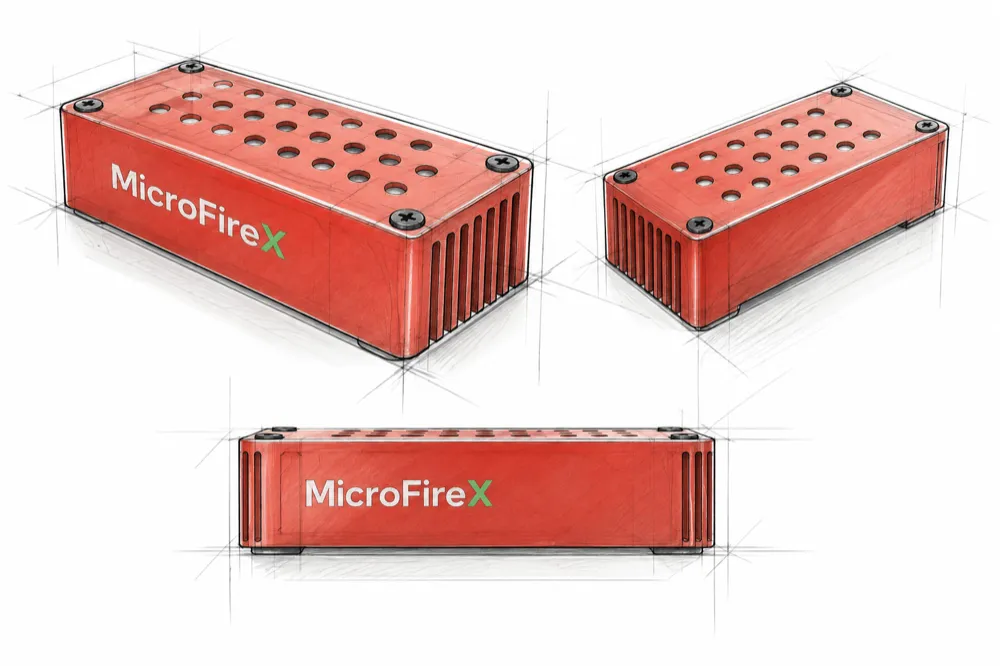
In fire-safety product development, most of the schedule isn’t lost in the lab — it’s lost undoing decisions that were made in the wrong order. The prototype works, the field trial goes well, and then, six months in, it finally becomes clear which regulations the product actually falls under, and the board has to be redesigned. The roadmap below sets out the order that avoids most of that rework, across four stages.
Stage zero: getting the CE concept right
“We got our CE certificate” has no legal meaning. CE is not a certificate issued by an authority — it is a mark the manufacturer affixes to the product under its own declared responsibility. Article 30 of Regulation (EC) No 765/2008 states that the mark may only be affixed by the manufacturer or its authorised representative, and Annex II sets its minimum height at 5 mm (EUR-Lex). The European Commission is explicit that CE marking does not mean the product has been approved as safe by the EU or any other authority (EC).
The correct terminology is a set of three, not one: the EU Declaration of Conformity is issued by the manufacturer; an EU-type examination certificate, or under the Construction Products Regulation a Declaration of Performance, is issued by a notified body; and the CE mark is affixed by the manufacturer. A national test-house report or an accreditation body’s certificate is not a substitute for any of these three.
Stage 1 — Requirements: start with the regulatory map
A fire-safety product rarely falls under a single piece of legislation. A housing rated above 0.5 bar falls under the Pressure Equipment Directive 2014/68/EU and is classified into Category I–IV by hazard level; equipment below the thresholds is built to “sound engineering practice” and does not carry CE marking (Article 4(3), EUR-Lex). Detection and suppression products permanently installed in buildings fall under the Construction Products Regulation (EU) 305/2011; the EN 54 series, EN 12094, EN 671 and EN 12259 are the harmonised standards here, subject to AVCP System 1 — type testing, initial factory inspection and ongoing surveillance (Euralarm/ZVEI). Detectors intended for explosive atmospheres fall under ATEX 2014/34/EU; the electronic board falls under the EMC and Low Voltage Directives; and if a radio module is fitted, RED 2014/53/EU applies in their place.
The costliest mistake here is the wrong address. Portable fire extinguishers (UN 1044) are explicitly excluded from the Transportable Pressure Equipment Directive 2010/35/EU — Article 2(1) says so directly (EUR-Lex), and Türkiye’s equivalent regulation was repealed in 2019. The correct address for an extinguisher body is PED.
Reducing requirements to a single list
A requirements definition is the sum of three sources: the essential health and safety requirements of the relevant directive, the harmonised standards, and the rules of the installation the product will actually go into. Applying a standard is not mandatory — Regulation (EU) 1025/2012 says so explicitly — but conformity with a standard whose reference has been published in the Official Journal creates a presumption of conformity (EUR-Lex); you are free to reject it, but then you carry the burden of proving equivalence yourself. If you’re selling into the Turkish market, the same table also needs Türkiye’s Regulation on Fire Protection of Buildings open in front of you (mevzuat.gov.tr) — it’s usually this text, not the EU directive, that sets the product’s actual technical targets.
Build the risk analysis as a skeleton, not an appendix
A risk analysis is not a document written after testing — it is the document that should be driving the design. ISO 12100:2010 sets out the sequence: hazard identification, risk estimation, risk evaluation and risk reduction (ISO). If every design decision is traceable back to which hazard it reduces and why, the backbone of the technical file is already in place from month one.
Stage 2 — Electronics and embedded software
Compliance cannot be bolted on afterward. EMC immunity and emission behaviour are determined by board layout, grounding and power architecture; EN 50130-4 (immunity) and EN 50130-5 (environmental testing) are the reference standards for fire alarm components. Running a pre-compliance scan on the first working prototype is dramatically cheaper than a failure report from an accredited lab months later.
On the embedded-software side, EN 54-2 places direct software requirements on control and indicating equipment. Its Clause 13, “Additional design requirements for software-controlled c.i.e.”, includes sub-clauses covering 13.4 program monitoring (watchdog), 13.5 program and data storage, and 13.6 monitoring of memory content (sample standard page). These are architectural decisions, not features you can add after the product is otherwise finished — memory-integrity checking and a watchdog mechanism have to be designed in from the start.
If the product connects to the internet, two more layers apply. RED Article 3(3)(d), (e) and (f) — protection against harm to networks, personal data and fraud — were activated by Delegated Regulation (EU) 2022/30, with the application date set at 1 August 2025 by (EU) 2023/2444 (EUR-Lex). On top of that comes the Cyber Resilience Act (EU) 2024/2847: reporting obligations from 11 September 2026, full obligations from 11 December 2027 (EC). A connected detector’s secure update mechanism needs to be planned against this timeline, not against the launch date.
Stage 3 — Module selection, testing and the notified body
Conformity assessment modules are defined in Annex II of Decision No 768/2008/EC: A, A1, A2, B, C, C1, C2, D, D1, E, E1, F, F1, G, H, H1. Only A and C require no notified-body involvement at all (decision text). “Every CE process needs a notified body” is a common but incorrect assumption:
| Legislation | Notified body | Note |
|---|---|---|
| LVD 2014/35/EU | Not required by any procedure | Module A only (EUR-Lex) |
| EMC 2014/30/EU | Optional | Annex II or Annex III (Article 14) |
| RED 2014/53/EU | Conditional | Mandatory under Article 3(2)-(3) if no standard exists or it doesn’t cover the scope |
| ATEX 2014/34/EU | Category-dependent | Internal production control suffices for Group II Cat. 3; mandatory for Cat. 1 |
| PED 2014/68/EU | Category-dependent | Module A for Cat. I; G, H1 or B+D/B+F for Cat. IV |
| CPR 305/2011 | Mandatory (AVCP 1) | Type testing + FPC surveillance |
| Pyrotechnics 2013/29/EU | Mandatory in every case | H for B+C2/D/E, G or F4 (EUR-Lex) |
Two rules when choosing a notified body: verify its identity in the NANDO database for that specific piece of legislation and that specific module (European Commission); and don’t expect design consultancy from it. Articles 21(3) and 21(4) of ATEX 2014/34/EU require the body to be an independent third party and prohibit activities that would compromise staff independence, stating explicitly that “this applies in particular to consultancy services” (EUR-Lex). Keeping design engineering support and certification with separate parties isn’t a stylistic choice — it’s a separation the legislation itself imposes.
The acceptability of a test report depends on the competence of the laboratory that issued it; accreditation bodies assess laboratories against ISO/IEC 17025:2017 (ISO). But when the selected module requires notified-body involvement, an accredited lab report on its own is not enough.
Cost can’t be reduced to a single figure, but the line items are predictable: purchasing standards and running the risk analysis, prototype revisions, test fees, type examination, setting up factory production control plus the initial audit, annual surveillance, multilingual manuals and labelling, and an EU-based authorised representative.
Stage 4 — The technical file and production-ready documentation
The minimum content of the technical file is listed in Annex II, Module A(2) of Decision 768/2008/EC: a general description of the product, design and manufacturing drawings and circuit diagrams, explanations needed to understand them, a list of the harmonised standards applied, design calculations, and test report results. The file is not submitted to an authority — the manufacturer keeps it for 10 years after the product is placed on the market and produces it to the market surveillance authority on a reasoned request. That retention period is the same across ATEX, PED, EMC, LVD, pyrotechnics and CPR.
Products under CPR additionally require a Declaration of Performance: product type code, intended use, AVCP system, the notified body’s identity and certificate reference, essential characteristics and the declared performance levels (EUR-Lex). A notified body’s identification number appears next to the CE mark only if that body is involved at the production-control stage — a body that performed only the type examination does not appear there (Directive 2013/29/EU, Article 20(3)).
Once production starts, what keeps the file alive is change management: factory production control procedures, translated versions of labels and manuals, batch/serial traceability, software version records, and an impact analysis for every design change showing which test result it invalidates. Under the Pyrotechnics Directive, each unit is additionally labelled with a registration number issued by the notified body that carried out its conformity assessment (Article 9); GRC Teknoloji’s micro suppression device, MicroFireX, was assessed under this regime using Module B+C and carries registration number 2806-P1-011688. The “design and manufacturing drawings” item in the technical file isn’t an abstraction: a sketch like the one at the top of this article, capturing the housing geometry, mounting holes and vent channels, is the first record of a design decision — made before it ever turns into a production drawing.
The Turkish side: who has authority, and who doesn’t
The framework law is No. 7223, the Product Safety and Technical Regulations Law (Official Gazette 12.03.2020/31066, replacing Law No. 4703). The competent authority varies by product: the Ministry of Trade for pressure equipment, pyrotechnics and ATEX; the Ministry of Environment and Urbanisation for permanently installed construction products; the Ministry of Industry and Technology for EMC; and for products containing a radio module, it isn’t a ministry at all — it’s BTK, the Information and Communication Technologies Authority. Accreditation and notified-body designation are also separate processes: accreditation comes from TÜRKAK, notified-body designation is made by the competent ministry, and notification to the Commission goes through NANDO via the Ministry of Trade (Ministry of Trade).
If you’re exporting into the EU, Article 4 of Regulation (EU) 2019/1020 is an obligation you cannot skip: a product within its scope can only be placed on the market if an economic operator established in the EU is responsible for compliance tasks. The list in Article 4(5) covers pyrotechnics, EMC, ATEX, LVD, RED, PED and CPR (EUR-Lex).
Two changes on the horizon
The Construction Products Regulation is being overhauled: (EU) 2024/3110 introduces a combined “declaration of performance and conformity” together with a digital product passport, with transition spread across a long timetable. The Machinery Regulation (EU) 2023/1230 replaces Directive 2006/42/EC on 20 January 2027 and extends its scope to machinery placed on the market without its software fully installed, to cybersecurity measures, and to safety functions with self-evolving behaviour (EU-OSHA).
Five things you can do tomorrow morning
- Write a one-page scope note for the product: which directives, which category, which standards. Every ambiguous line in that note is a redesign waiting to happen.
- Write your module decision underneath that note and justify it; if a notified body is required, verify candidates in NANDO against that exact legislation and module.
- Open the risk-analysis file under the ISO 12100 headings and link your existing design decisions to it.
- Book the pre-compliance (EMC and environmental) measurement slot for the first working prototype before the design freezes — not after.
- Create the technical-file folder today and put it under version control; the 10-year retention obligation means the file has to live as long as the product does.
None of these five steps is a notified body’s job — by law, it can’t be. If you bring in outside help for design, embedded software or the technical file, that support has to run through a party separate from certification; that’s the space GRC Teknoloji’s R&D and Engineering services work in.
Sources
- Regulation (EC) No 765/2008, Art. 30 and Annex II
- European Commission — CE marking
- Decision No 768/2008/EC, Annex II (modules and technical file)
- Directive 2014/68/EU — Pressure Equipment Directive (PED)
- Directive 2010/35/EU — TPED, Article 2(1) exclusion
- Directive 2014/34/EU — ATEX, Articles 13 and 21(3)-(4)
- Directive 2014/35/EU — Low Voltage Directive
- Directive 2014/30/EU — EMC, Article 14
- Directive 2014/53/EU — RED, Articles 3 and 17
- Commission Delegated Regulation (EU) 2023/2444 — RED cybersecurity application date
- Directive 2013/29/EU — Pyrotechnics, Articles 6, 9, 17, 20(3)
- Regulation (EU) No 305/2011 — Construction Products Regulation
- Regulation (EU) 2024/3110 — new Construction Products Regulation
- Regulation (EU) No 1025/2012 — European standardisation
- Regulation (EU) 2019/1020, Article 4 — EU-based responsible economic operator
- European Commission — Cyber Resilience Act
- EU-OSHA — Regulation 2023/1230/EU Machinery Regulation
- Euralarm/ZVEI — CPR guidance (EN 54, EN 12094, EN 671, EN 12259; AVCP 1)
- EN 54-2 Clause 13 — software-controlled equipment requirements (sample page)
- ISO/IEC 17025:2017
- ISO 12100:2010
- European Commission — NANDO / Notified bodies
- Turkish Ministry of Trade — Notified Bodies
- Law No. 7223 on Product Safety and Technical Regulations
- Turkish Construction Products Regulation (305/2011/EU) — Official Gazette 10.07.2013/28703
- Turkish EMC Regulation — Official Gazette 02.10.2016
- Turkish Radio Equipment Regulation (2014/53/EU) — Official Gazette 05.11.2020/31295
- Turkish Regulation on Fire Protection of Buildings
- TÜRKAK — Frequently Asked Questions