
Insights / Enterprise Call Handling and Voice-Message Automation: GRCSipAgent
Enterprise Call Handling and Voice-Message Automation: GRCSipAgent
30 August 2026 · GRC Teknoloji · 3 min read
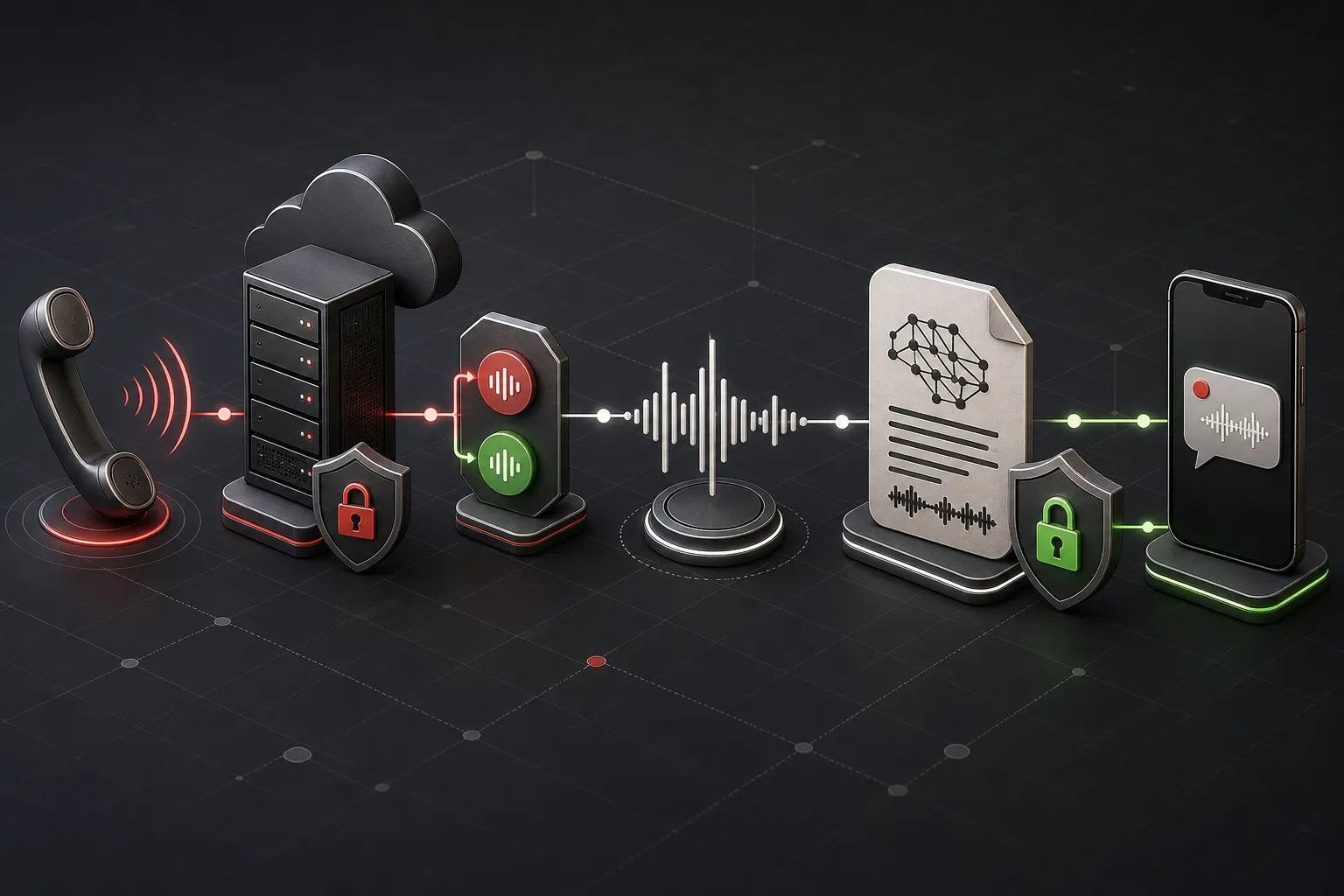
One of the least visible sources of lost business is the unanswered telephone call. For small and medium-sized organisations, calls arriving outside working hours or during busy periods are often never captured. When they are, a standard carrier voicemail service rarely speaks in the organisation’s own voice, does not route the message into its operational workflow and may leave uncertainty about where the recording is stored.
The GRC Teknoloji R&D team developed GRCSipAgent to close that gap: a system that manages the call-handling process end to end on infrastructure controlled by the organisation.
The objective
The goal was to give the organisation control from the first second of an incoming call. GRCSipAgent answers the call on its own server, plays a company-specific announcement, records the caller’s message, converts the recording into text and delivers a notification to the relevant person within seconds.
An otherwise “missed call” becomes a searchable, actionable digital record that can be read and prioritised without first listening to the entire recording.
Technical approach
At the core of the solution is an open-source SIP/VoIP server combined with a call-flow—or dialplan—layer developed for the project. The system runs in containers in the cloud, while configuration files are generated automatically from templates. This makes deployments repeatable and allows the same architecture to be adapted to multiple organisations without rebuilding it from scratch.
The project currently brings together the following capabilities:
- Multi-line call handling: Several telephone lines can be managed on one server, with a separate identity and recorded greeting for each line.
- Bilingual IVR: Callers can use keypad input to select a Turkish or English flow. The selected language is carried into the resulting notification.
- AI-assisted transcription: The voice message is processed by a speech-recognition model and the transcript is attached to the notification, allowing recipients to scan and prioritise messages quickly.
- Immediate delivery and data hygiene: The audio recording and transcript are delivered through an instant-messaging channel. After confirmed delivery, the server copy is removed automatically, reducing both storage consumption and the burden associated with retaining personal data.
- Browser-based calling with WebRTC: Users can place calls through an encrypted browser session or a web application installed on a mobile home screen, without a separate native application. The outbound line can be selected before the call.
- Security controls: Encrypted signalling, automated certificate renewal and a defensive layer that blocks internet-originated SIP attacks in real time are built into the operating model.
- Web administration: Announcements, line settings, notification integrations and the message archive can be managed through a browser interface designed for non-specialist users.
Why organisation-controlled infrastructure matters
Conventional voicemail services can capture a basic message. Enterprise use, however, requires the call flow, language choices, delivery channel, retention policy and downstream integrations to be managed as one system.
With the GRCSipAgent approach, an organisation can:
- Define which greeting and workflow answer each line.
- Understand which systems process the recording and transcript.
- Control who receives each message and through which channel.
- Apply a defined retention policy after successful delivery.
- Provision additional lines or organisations through the same repeatable architecture.
This provides more than technical independence. It makes the complete lifecycle of call data visible and manageable.
Results and roadmap
GRCSipAgent has progressed beyond an early laboratory prototype. Calls are being answered, voice messages are delivered with their transcripts, and processing takes place on server infrastructure under organisational control.
The next development areas include:
- Additional notification channels,
- AI-assisted summarisation and prioritisation of message content,
- Broader authorisation and audit capabilities,
- A multi-tenant service model for supporting several organisations securely.
GRCSipAgent is a practical example of GRC Teknoloji’s engineering approach: building and controlling the underlying infrastructure instead of remaining dependent on a ready-made service.