
Insights / Wi-Fi HaLow vs. LoRa: Which Technology Is Best for Long-Range IoT?
Wi-Fi HaLow vs. LoRa: Which Technology Is Best for Long-Range IoT?
11 September 2026 · GRC Teknoloji · 8 min read
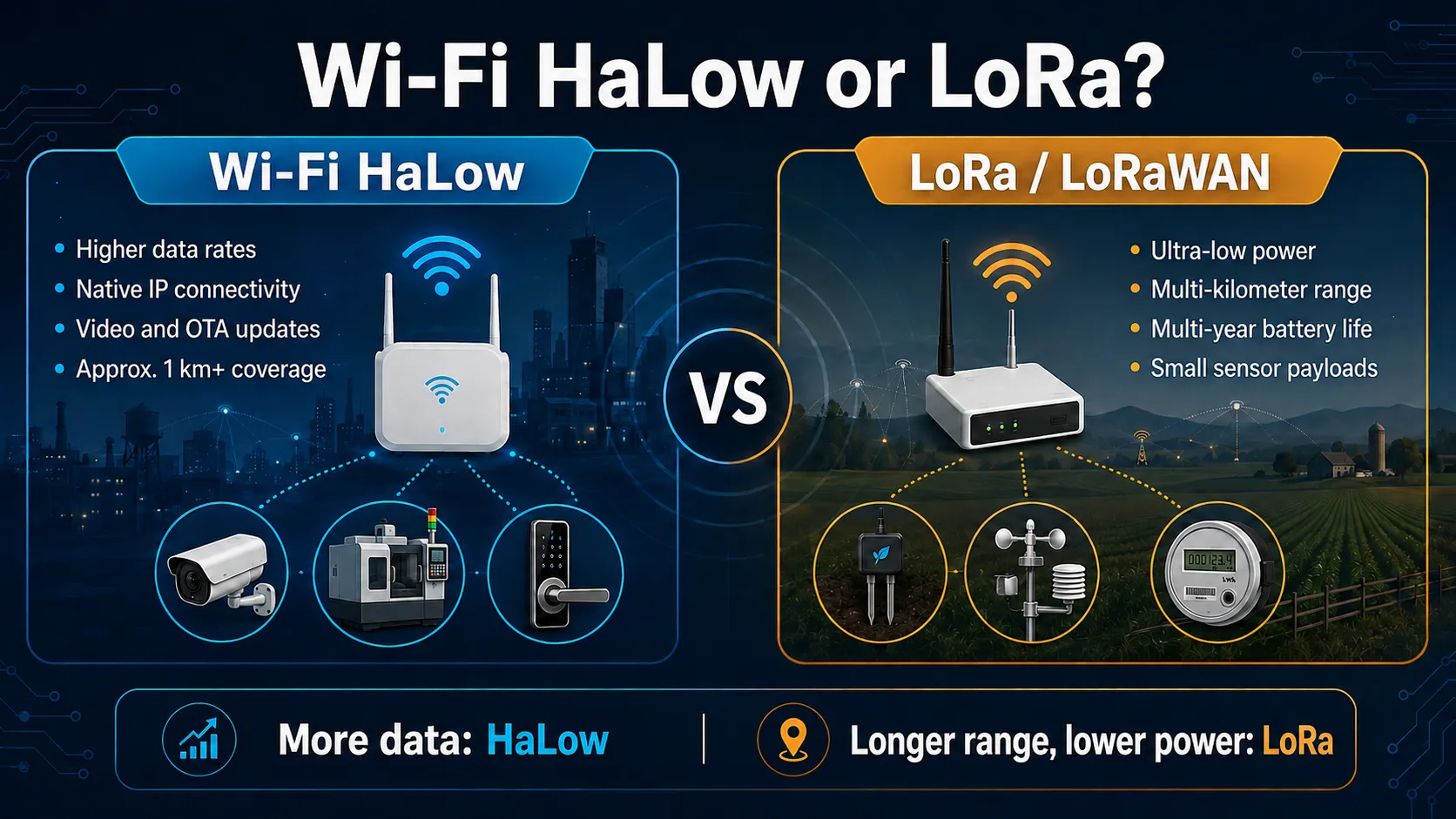
When an IoT project requires long-range wireless connectivity and low power consumption, two technologies often stand out: Wi-Fi HaLow and LoRa/LoRaWAN.
Both take advantage of sub-1 GHz frequencies to provide better range and obstacle penetration than conventional Wi-Fi. However, they are designed to solve different problems:
LoRa is optimized for sending small amounts of data over long distances with minimal energy use. Wi-Fi HaLow is designed to carry more data over an IP-based, long-range network.
So, which one is right for your project?
Quick Comparison
| Feature | Wi-Fi HaLow | LoRa/LoRaWAN |
|---|---|---|
| Core standard | IEEE 802.11ah | LoRa physical layer + LoRaWAN network protocol |
| Spectrum | Region-dependent sub-1 GHz bands | Region-dependent license-exempt bands |
| Primary use | Medium-to-high data IoT connectivity | Small, infrequent sensor messages |
| Range | Around 1 km or more under suitable conditions | Several kilometers outdoors; potentially farther in ideal conditions |
| Data rate | From hundreds of kbps to several Mbps, depending on configuration | Generally measured in kbps |
| Power consumption | Lower than conventional Wi-Fi, but usually higher than LoRa | Very low |
| Network architecture | Access point with native IP connectivity | End devices, gateways and a LoRaWAN network server |
| Large data transfers | Relatively suitable | Not suitable |
| Battery life | Months or years, depending on usage | Potentially many years |
| Best suited for | Cameras, access control, audio and OTA updates | Metering, agriculture, environmental monitoring and asset tracking |
Actual range and battery life depend on factors such as antenna design, terrain, building materials, transmission frequency, payload size and local radio regulations.
What Is Wi-Fi HaLow?
Wi-Fi HaLow is based on the IEEE 802.11ah standard and operates in license-exempt spectrum below 1 GHz. Its lower operating frequency can provide wider coverage and better penetration through walls and other obstacles than conventional 2.4 or 5 GHz Wi-Fi.
IEEE 802.11ah was designed to provide a transmission range of up to approximately one kilometer and a minimum data rate of at least 100 kbps under suitable conditions. Depending on channel width and signal conditions, physical-layer speeds can reach several Mbps.
This means Wi-Fi HaLow is not limited to a few bytes of sensor data. It can also support applications such as video transmission, access-control systems, industrial monitoring and over-the-air software updates. (IEEE 802.11ah overview)
One of its main advantages is native IP connectivity. Devices can communicate using familiar protocols such as MQTT, HTTP, TCP/IP and TLS, making integration with existing Ethernet and Wi-Fi infrastructure relatively straightforward.
Key advantages of Wi-Fi HaLow
- Higher data capacity than LoRa
- Bidirectional, IP-based communication
- Better suited to remote software and firmware updates
- Better range and obstacle penetration than conventional Wi-Fi
- Easier integration with enterprise network management and security systems
That additional capacity generally comes at a cost: Wi-Fi HaLow typically consumes more energy and provides less range than LoRa in comparable low-data applications.
What Are LoRa and LoRaWAN?
Although the terms are often used interchangeably, they do not mean exactly the same thing:
- LoRa is the physical radio technology used to transmit signals.
- LoRaWAN is the networking architecture and communication protocol built on top of LoRa.
LoRaWAN is designed to carry small payloads such as temperature readings, humidity measurements, meter values, location updates or alarm states over long distances.
End devices transmit their messages to one or more gateways. The gateways then forward those messages to a central network server over an IP connection.
LoRaWAN data rates vary according to regional parameters and radio settings, but they generally remain in the kbps range. This is not simply a limitation—it is a deliberate trade-off that helps reduce energy consumption and extend communication range.
The LoRa Alliance notes that LoRaWAN is not designed for large data transfers or millisecond-level real-time communication. However, devices that send small, infrequent messages can operate for years with a properly designed battery and transmission schedule. (LoRaWAN technical overview, What LoRaWAN is—and is not—designed for)
Key advantages of LoRa
- Extremely low energy consumption
- Multi-kilometer outdoor coverage
- Wide-area coverage using a relatively small number of gateways
- Scalable architecture for large numbers of low-data devices
- Private network deployment without cellular subscriptions
LoRa is not a good fit for continuous video, audio, large files or frequent firmware transfers. As message sizes and transmission times increase, so do battery consumption and radio-channel occupancy.
When Should You Choose LoRa/LoRaWAN?
LoRa/LoRaWAN may be the better choice if:
- You are transmitting small readings such as temperature, humidity, pressure or device status
- Sensors are distributed across a large geographical area
- Devices need to run for years without battery replacement
- Data is transmitted only at scheduled intervals or when an event occurs
- Your project involves agriculture, environmental monitoring, smart metering or asset tracking
- You want to cover the deployment area with a limited number of gateways
When Should You Choose Wi-Fi HaLow?
Wi-Fi HaLow may be the better choice if:
- You need higher data rates than LoRa can provide
- Your devices transmit images, audio or larger data packets
- You need to distribute frequent or relatively large software updates
- You want to use MQTT, HTTP, TCP/IP or TLS directly
- Integration with an existing Ethernet or IP network is important
- Enterprise-grade network management and security are priorities
A Simple Rule for Choosing
You can simplify the decision by asking one question:
Does the device only need to report a few sensor values, or does it need a true network connection?
For the first scenario, LoRa/LoRaWAN is usually the stronger candidate. For the second, Wi-Fi HaLow will often be more suitable.
For example, LoRa is an excellent option for collecting soil-moisture readings once an hour from sensors distributed across a farm. If the same site includes security cameras, access terminals or equipment requiring large software updates, Wi-Fi HaLow may be the better fit.
Using the 868 MHz Band in Türkiye
Different portions of the 863–870 MHz range may be used by short-range devices in Türkiye, provided that the applicable technical conditions are met. This does not mean that every frequency within the band can be used continuously or at any desired transmission power.
The limits defined by Türkiye’s Information and Communication Technologies Authority, or BTK, vary according to the sub-band and type of equipment. For many general-purpose applications in the 863–870 MHz range, the maximum power is 25 mW e.r.p.
Depending on the selected sub-band, a 0.1%, 1% or 10% duty-cycle limit may apply. Alternatively, the equipment may need to support interference-mitigation mechanisms such as Listen Before Talk and Adaptive Frequency Agility—LBT+AFA.
Examples include:
- In the 868–868.6 MHz range, the general limit is 25 mW e.r.p. with a 1% duty cycle or LBT+AFA.
- In the 868.7–869.2 MHz range, the limit is 25 mW e.r.p. with a 0.1% duty cycle or LBT+AFA.
- In the 869.4–869.65 MHz range, up to 500 mW e.r.p. and a 10% duty cycle or LBT+AFA may be permitted under the specified conditions.
- Wideband systems may be subject to additional requirements covering channel width, power density and access-point control.
The current requirements should be verified in BTK’s official document: Technical Criteria for Radio Devices and Systems Exempt from Frequency Assignment.
Therefore, a product label stating only “868 MHz” is not enough. Before deployment, confirm that the equipment:
- Supports the correct frequency plan for Türkiye
- Meets the applicable transmission-power and duty-cycle limits
- Provides any required interference-mitigation mechanisms
- Satisfies the relevant conformity-assessment and marking requirements
Devices designed for the US 902–928 MHz market may not become compliant in Türkiye through a simple software change. Their supported frequencies and radio hardware should be verified before use.
Can Wi-Fi HaLow and LoRa Be Used Together?
You do not always have to choose only one technology. In some projects, a hybrid architecture provides the best result.
For example, low-data sensors across a large industrial site could report through LoRaWAN, while security cameras, access-control terminals and higher-data machines connect through Wi-Fi HaLow.
This approach combines LoRa’s range and battery-life advantages with HaLow’s higher data capacity and native IP connectivity.
Conclusion: The Use Case Determines the Winner
There is no universal winner between Wi-Fi HaLow and LoRa.
If your priority is moving small amounts of data over long distances with minimal energy consumption, LoRa/LoRaWAN is likely the better choice. If you need higher data rates, native IP connectivity and easier integration with existing networks, Wi-Fi HaLow may be more suitable.
Before making a decision, answer four questions:
- How much data will each device transmit per day?
- What coverage distance is genuinely required?
- What is the target battery life?
- Do the selected frequency, transmission power and airtime comply with local regulations?
The answers will usually make the right technology much easier to identify.